OLD KUCHING: CARPENTER STREET PART 4. BLACK BEAN COFFEE

2 Comments »


H
idden away at the edge of Carpenter Street, you might be wondering why such a small café might be full (It’s not just because they only have three tables). Being a café located in the part of town where cafés are usually designed as “tourist bait”, selling expensive foreign coffee equivalent to black watery dirt and faking their way into unsuspecting hearts with their “local” decor, Kuching-ites may feel wary in trusting just any café. Besides, who could blame them?

If you can suspend your scepticism and stop by to soak in the stained columns, white coated walls and charming setup, this shop which epitomises Classic Kuching might just entice you to grab a seat. If you have, you might have also been enticed to grab a cup of coffee. Once you’ve had your coffee and taken your first sip, congratulations! You now understand why so many stay and why it’s worth the wait even when this place is full. You now understand that this is not just any “tourist bait”. Quite the opposite. You’re experiencing the real deal of what Local Sarawak Coffee is like.

Opened in 2001, Black Bean has managed to take local Liberica coffee beans to new heights by steering away from the norm of promoting Arabica beans. Arabica beans have rightly so been the Coffee species of choice, yielding a large array of different flavour and aroma profiles. What Liberica beans do provide though is a different matter. Not better, but different. What kind of different though? The good kind of different.


Unlike beans that we are used to that are pre-roasted and packed for us, Black Bean is one of the two prominent cafés that roast their own beans. What in-house roasting does is present us with a flavour that is exactly the way the owner intended for us to taste. It is the attention to detail from the way these beans are personally picked after acquiring them from a local plantation, to the way it is roasted to form the flavour you are picking up with your palates.

Now the way you’ll want to pick up these flavours starts from a single cup of espresso which is the base for our favourite coffee drinks. The water to coffee ratio in the espresso here is estimated to be 1:3 so it makes for easier drinking and upon first sip, you will want to take a whiff of your coffee before spraying it on your tongue by said sipping.


Before we continue, I might add that it takes years to pick up all the notes from your cup of coffee and though I do not have the experience, I can do my best tell you what most of us who are not coffee aficionados might pick up.

You will be able to pick up hints of berry and nutty aromas while the flavour spraying your tongue will carry an earthy and mildly dark chocolaty flavour. It must be noted as well that this espresso is a blend of Liberica and Robusta and the latter brings about a pleasant bitterness that we are so fond of in our coffee. This is only possible due to the care that is taken from the roasting process all the way to manually pulling the espresso unlike many cafés you might encounter. You will not find many places in Kuching that not only do this, but proudly serve beans that make up 2% of coffee produced in the world.

There are many things that could have gone wrong with this cup, but for all the things that could have gone wrong.. What Black Bean has done by no easy feat, is create a good cup of coffee.

Now because the base of your coffee is done right, we know that we do not have to worry too much about how the rest of our coffee choices will turn out.


As for these choices, you may choose to add brown sugar which is a good additive if you like something a little sweeter while adding a fuller body, or even milk that Black Bean does well to add enough of said flavour and body that you require to enhance your coffee experience.

Iced Latte 
Iced Cappucino
Cappucino 
Latte
Regardless of what you choose to add, I will never go so far to say that these additives will contaminate your coffee experience, but done well like in Black Bean, these will enhance what you enjoy most with your coffee and trust me; Black Bean is one of those rare cafés that does it well.

Black Bean is open from Monday to Saturday and from 9:00am to 6:00pm.


You may find them using the following Google Map Location found below and if you have liked reading this post, please like, share and comment to share your views! Much Love!


OLD KUCHING: CARPENTER STREET PART 3, KIM JOO

No Comments »


A
sking who Mr Kim Joo was, had to be one of the stupidest questions I had ever asked a store owner. It was a combination of curiosity and me trying to crack a joke. Unbeknownst to me and maybe quite a few patrons over the years, there never was a Mr Kim Joo. According to Mr Ming, the grandson of the founder of Kim Joo, it apparently was just a cool name Mr Ming’s grandfather made up for the coffee shop we know now today.


Though Kim Joo is a coffee shop whose age spans three generations, it was not until Mr Ming’s mother ran the shop that it began to sell Kolo Mee. For the older generation who were patrons of Mr Ming’s grandfather, they will know Kim Joo as a cake shop as opposed to a place now famous for its Kolo Mee. It isn't known when exactly Mr Ming’s grandfather started his business, but what is known is that they've been registered here since 1953.

Fast-forward back to 2015, Kim Joo is a quaint coffee shop that you might glance over if you’re not adventurous enough. Of course, you’d be missing out if you did. The simple layout makes for a pretty chill and care-free feel, while the family members that run Kim Joo, are welcoming and always keen to strike up a conversation.


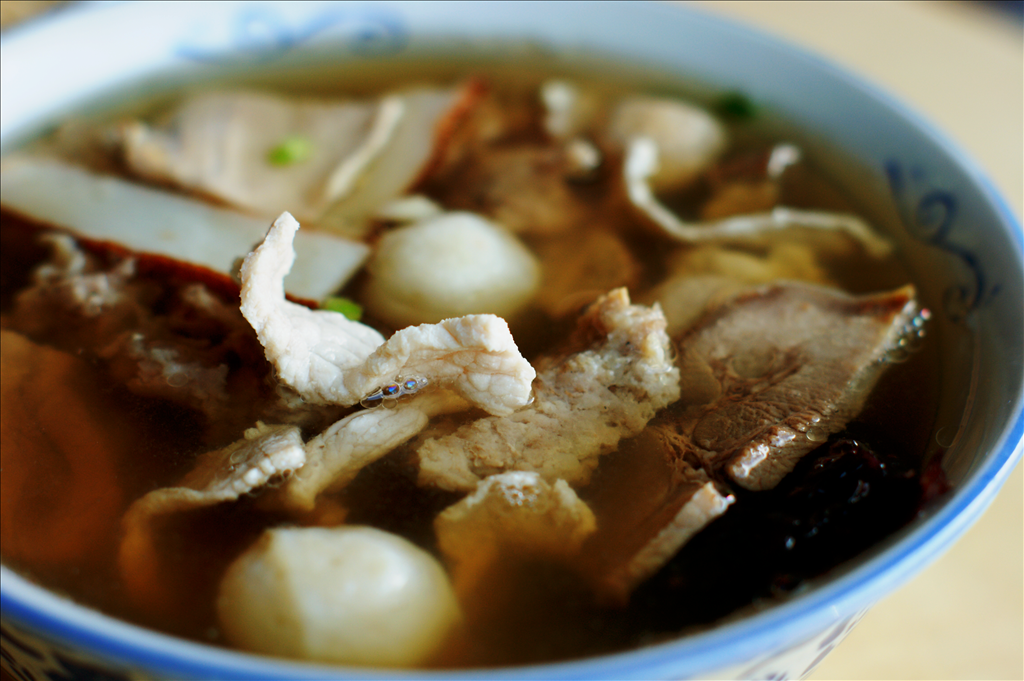
Of course, they recommended me to try the Kolo Mee while I also requested to try the “Cheng”, which they are also famous for. Cheng, if you’re not familiar with the term – is what people in Kuching use to describe mixed pork soup that accompanies a bowl of plain Noodles.


My order was a little unconventional as I ordered Cheng for two portions with two bowls of Straight Mee and Mee Pok (Local lingo used to describe thin flat noodles) topped with Char Siew and some fried garlic. The total damage for that meal including two drinks was RM19.50.


I have never been a big fan of Cheng, especially when they involve me waiting an hour for *Ahem*, but I have found myself rather enjoying this comforting bowl of soup. If you're wondering, it didn't take very long at all to arrive at my table. Back to the Cheng, it is rather unconventional as most Cheng I’ve tried has strong flavours of pork, whereas the flavour of pork in this bowl is more of an accompaniment to the flavour of seaweed. It isn’t a bad thing, as it brings a good fresh contrast to the heavy flavours usually found in Cheng.  


It is good to note, that the pickles present also bring a good sourness while the bean sprouts add a good crunch of texture as you dig through the soup. Among the other worthy ingredients found here are the meatballs that are springy, and pieces of meat and spare parts that were cooked well. I must note that I didn’t taste much or any seasoning for the meats in this bowl, but I suppose it was done to not clash with the flavour of the soup.


The star of the meal comes in the form of these noodles. Cooked well to be rather springy and al dente while being drizzled with black vinegar, lard and topped with fried garlic and the all-important Char Siew. The black vinegar brings sourness to the aroma of the pungent garlic to provide a good bright flavour of balance to the noodles.


The Char Siew is disappointingly similar to most places in terms of the lack of flavour in them. Regardless, it is juicy and the fat present is evident of a certain home-made care.

Overall, it is easy to see why Kim Joo is popular among new and old clientele as the homey atmosphere coupled with the Asian equivalent of Soul Food is both comforting and delicious. What is hard instead, is to imagine a Carpenter Street without Kim Joo after how long it has made its mark within the hearts and satisfied tummy’s of the Kuching people.

Kim Joo’s operating hours are listed in the picture below.


You may also find them at this location.


Thank you for reading, so please like, share and comment if you have enjoyed reading this post. As a little gratitude, here's a sneak preview of where we'll be headed next Tuesday around 7 to 8pm Malaysian Time :) 


OLD KUCHING, CARPENTER STREET PART 2: NYAN SHIN

No Comments »


A
mong all of the places we’ll visit throughout this multi-part series of food, none holds a greater place in my heart within this street than Nyan Shin. No it isn’t the cute setup they have, but how family oriented this shop is. Yes, you will see family members from cute grannies to grandkids that are currently in their early 20’s, but those aren’t who I’m mainly talking about. I’m talking about you too. The customers.


Badass Old guy and Candid Shot with me in glasses


In my experience at least, I’ve never felt unwelcome. Even when a trip is months apart from the last, the owner will exclaim, “Minced Beef Noodles!” when I try to order.


As hospitable as they may be though, good hospitality isn’t enough to bring you forward in the food industry. Fortunately, hospitality isn’t the only thing that draws customers here as the food is superb. Besides, you don’t get to sell the exact same bowl of noodles for three generations spanning the course of a century if it wasn't the case.


First of all, the noodles here are a little different from what you may be used to. Not only are they fresh, but they are also home-made. The noodles maintain its springiness while soaking up the juices (which also usually are topped up with lard by the way) that they are exposed to, thus creating noodles with mildly different tastes depending on what bowl you order.


Its ability to soak up juices is admittedly prone to drying to dish quicker than most, which means a drier bowl of noodles if you’re not quick to act. My word of advice is to not spend most of your time taking food pictures for your food/travel blog if you want to make sure that you finish this quickly before it dries up.


On that note, let’s try us some Hakka Noodles!


If I have to be honest, this is the most lacklustre of the few you will try here. On top of the noodles, you will have fresh spring onions that add a full aroma on top of the Char Siew and Minced Pork. 


The Char Siew isn’t anything to really sing about as it’s too thinly sliced to notice if it’s juicy or not, while the Minced Pork on the other hand is juicy and appropriately sized to still be able to taste mild flavours of pork.


The Wan Tan Noodles are similar in hand with the Kolo Mee in the sense that it is also topped with similar garnishes, but what the Wan Tan noodles lack in ingredients, it does well in its simplicity – if that’s what you’re looking for.


The Wan Tan has a nice bite to its skin as you can see, while still being soft. The inside of the Wan Tan is a good mixture of fat and pork meat that you can still taste the texture of the grounds as it isn’t overworked. Mind you, there might be a little more MSG for those who don’t like the taste.


The Taiwan Beef Noodles, as the name suggests isn’t really one of their more traditional bowl of noodles that they sell here. The noodles swim in a savoury beef flavoured broth while topped with some fresh herbs, a sliced tomato (which feels a little out of place), pickled cabbage and slices of juicy beef.


The pickles contrary to what you may expect, is more salty than sour while the slices of beef are mildly seasoned to bring out the flavours of beef. Together, they aren’t as balanced as one might like as it leans more towards the saltier side of things but once again, to each his own.


If the Taiwan Beef Noodles bring forth natural flavours of the meat used, the Mutton noodles do the same in bringing out the natural flavours of Mutton. 


The slices are thick enough to feel the texture of the juicy Mutton and are cooked perfectly to slide off the bone. In terms of garnishes, it’s rather simple with only herbs to top it but it does well to balance the heavy flavours of the Mutton.


The coup de grace to this trip is the Minced Beef Noodles. This bowl is my personal favourite and is the noodles that have brought Nyan Shin to fame since its first inception about a century ago – and it’s easy to see why.


While simple at first glance, the textures that play in your palate is the combination of crispy pork and garlic that top the juicy Minced Beef. 


They are not stingy with their portion either, as this amount ensures that you have everything you need with each pull of noodles if mixed well. The balance of Beef and Pork sing as the pork complements the flavour of beef with crunchy pork bits and lard that coats the Minced Beef.


This business has been alive for a long time, and it makes perfect sense when you look back on the warm welcome that this family gives to their customers as well as providing delicious food. It seems fitting that an establishment with their legacy chose to set up shop in one of the most historical food streets in Kuching. Carpenter Street is very lucky to have had them within its company for the 20 years it has been here.


Nyan Shin is currently open every day from 6:30AM to 1:00PM if they do not sell out early – which they usually do, mind you!